
The key difference between oil-free and oil-lubricated air compressors lies not in their appearance or displacement, but in whether lubricating oil enters the compression chamber to participate in the compression process. This distinction directly determines the oil content of the compressed air, the consumable components, maintenance priorities, and suitable operating conditions. This article explains the differences between the two types from the perspectives of working principle, air quality, cost, maintenance, and selection criteria, helping users choose the appropriate model based on their actual air‑demand requirements.
Key difference: Whether the lubricating oil comes into contact with the compression chamber.
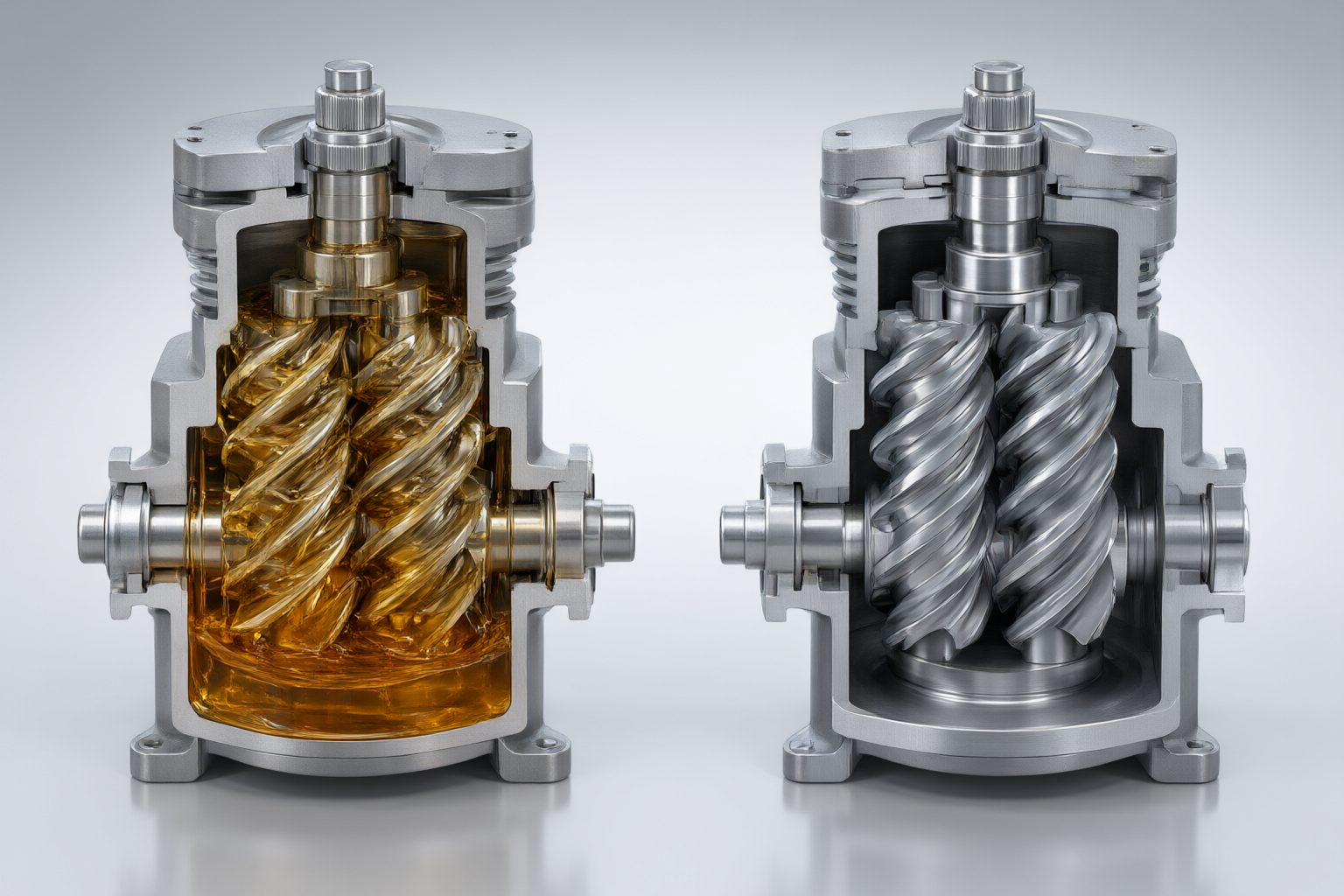
In oil-lubricated compressors—such as typical oil-injected screw compressors and some reciprocating compressors—lubricating oil is directly injected into or enters the compression chamber during the compression process, where it performs lubrication, cooling, and sealing functions. After compression, the oil–air mixture passes through an internal oil–gas separator, which recovers most of the oil; however, a certain amount of oil still remains in the discharged compressed air and must be further removed by downstream filters.
In an oil-free air compressor, the compression chamber does not come into contact with lubricating oil; the compression process takes place in an oil-free environment. It is important to note that “oil-free” typically refers only to the absence of oil in the compression chamber—some models may still use lubricating oil in their bearings and gearboxes, which are isolated from the compression chamber by seals or similar components. Therefore, to determine whether a machine meets your air‑use requirements, you should rely on actual measurements of the oil content in the compressed air, rather than simply relying on the “oil-free” designation.
Quick comparison of two机型
| Comparison item | Oil-free air compressor | Oil-lubricated air compressor |
|---|---|---|
| Compression chamber lubrication | The compression chamber does not come into contact with lubricating oil. | Lubricating oil enters the compression chamber. |
| Compressed air contains oil. | Prevent oil contamination in the compression chamber at the source. | Residuals remain after in-flight separation and require post-processing. |
| Initial acquisition cost | Under the same gas volume conditions, it is usually higher. | Usually lower |
| Subsequent consumables | Oil-free consumables for the compression side | Lubricating oil, oil filter, oil-air separator element |
| Key maintenance points | Air filter, shaft seal, cooling system, etc. | Fuel System Condition and Oil Change Interval |
| Applicability tendency | Oil-sensitive process | General-purpose compressed air |
Differences in compressed air quality
The most straightforward difference between the two types of compressors lies in the oil content of the compressed air. Oil-lubricated compressors, even after internal oil–air separation, still discharge air containing residual oil; oil-free compressors eliminate oil contamination at the source, resulting in significantly lower oil levels in the discharged air.
When there are quantitative requirements for air quality, industries typically refer to compressed air purity classification standards (such as ISO 8573-1) Classifies compressed air based on oil content, moisture content, and solid particle levels. The stricter the purity requirements, the more likely it is to opt for an oil-free solution; for general pneumatic tools and general manufacturing applications, appropriately configured post-treatment equipment (such as dryers and multi-stage filters) can usually meet the requirements, but whether the specified standards are actually achieved should be determined by actual test data.
Differences in cost structure
- Initial purchase:Under the same air displacement conditions, the overall price of an oil-free air compressor is typically higher than that of an oil-lubricated model.
- Subsequent consumables:Oil-lubricated compressors require regular replacement of lubricating oil, oil filters, and oil–gas separators. Oil-free compressors eliminate these oil-related consumables on the compression side; however, different types of oil-free compressors have their own specific maintenance requirements.
- Post-processing input:When oil‑powered equipment is used in applications with specific oil cleanliness requirements, multi‑stage filtration must be installed, and the replacement of filter elements constitutes a long‑term cost.
- Energy consumption:The energy consumption levels of the two types depend on the equipment model, discharge pressure, operating conditions, and overall efficiency design; it is not appropriate to assume that one type is universally more energy-efficient—evaluation should be based on the specific data for each model.
When comparing costs, it is recommended to estimate based on the full lifecycle: include the purchase price, electricity costs, consumables and maintenance, as well as post-processing expenses, rather than simply comparing quoted prices.
Differences in maintenance methods
Maintenance of oil-lubricated compressors revolves around the oil system: replace the lubricant, oil filter, and oil separator at prescribed intervals, and monitor for abnormal conditions such as oil degradation or emulsification. The condition of the lubricant directly affects the life of the compressor head, and delaying oil changes is one of the most common causes of failure in oil-lubricated units.
Oil-free compressors do not require maintenance of the oil circuit on the compression side, but they still need periodic servicing of components such as the air filter, as well as inspections of the shaft seals and cooling system. Specific maintenance tasks vary depending on the compressor type (e.g., dry screw, water-lubricated, scroll, or oil-free piston) and should be performed according to the manufacturer’s maintenance manual. The notion that “oil-free equals maintenance-free” is a common misconception.
Scenario preference
- Tends toward oil-free machines:Food and beverage, pharmaceutical, electronics, laboratory, precision coating, and other processes that are sensitive to oil contamination in compressed air, or applications where compressed air comes into direct contact with the product.
- Tends to favor oil-powered engines:For general industrial applications such as factory power air, pneumatic tools, cylinder actuation, and general machining, proper post-treatment is usually sufficient to meet the requirements.
This is merely a preliminary assessment; the final determination should be based on the air quality grade required at the point of gas usage. When different workstations within the same facility have varying requirements, a zoned air supply system may also be implemented.
Selection and judgment steps
- Clearly define the oil content requirements for each gas end-use point and determine the required air quality grade.
- Determine whether an oil-free compressor is required for this grade, or whether an oil-lubricated compressor with multi-stage filtration would suffice.
- Compare feasible options based on total life-cycle costs, including acquisition, energy consumption, consumables, and post-processing expenses.
- Assess site conditions: ambient temperature, dust levels, water quality (for water-lubricated models), installation space, and noise requirements.
- Request the actual data and maintenance plan under the corresponding operating conditions from the supplier before making a decision.
Common misconceptions
- Myth 1: Oil-free air compressors contain absolutely no oil.Most oil-free compressors only have an oil-free compression chamber; the bearings or gears may still use lubricating oil.
- Misconception 2: Adding a filter to an oil-lubricated compressor automatically turns it into an oil-free compressor.Filtration can reduce oil content, but its effectiveness is influenced by the filter element’s grade, maintenance condition, and operating conditions. Whether it can replace an oil-free compressor depends on the specific air‑use requirements.
- Myth 3: Oil-free machines are always more energy-efficient or cost-effective.Energy consumption and total cost depend on the specific model and operating conditions and must be calculated on a case-by-case basis.
Selection Conclusion
The fundamental difference between oil-free and oil-lubricated air compressors lies in how oil comes into contact with the compressed air during the compression process, which in turn affects air quality, cost structure, and maintenance requirements. The key to selecting the right compressor is not to ask “which is better,” but rather to assess the actual compressed-air requirements at the point of use: when the process is sensitive to oil or demands a high purity grade, an oil-free compressor should be prioritized; for general power applications, an oil-lubricated compressor paired with appropriate post-treatment is often the more economical choice. By evaluating total life-cycle costs and real-world test data, you can avoid overpaying for unnecessary cleanliness while also preventing compromises in product quality due to overly tight initial budget constraints.
There are no comments yet. Be the first to comment!