
There is no single, fixed interval that applies to all air compressor models for oil changes. The oil-change cycle depends on the compressor’s design, the type of oil used, the operating environment, and the load conditions. The most reliable guide is the equipment manual or the maintenance schedule provided by the manufacturer. The following discussion covers the influencing factors, how to assess oil condition, key points for performing an oil change, and common misconceptions, helping you make informed decisions when clear guidance is lacking.
What factors determine the oil change interval?
Model structure
Reciprocating and screw air compressors employ different lubrication methods. In reciprocating compressors, the lubricating oil primarily serves to lubricate the piston–cylinder interface; high temperatures and carbon deposits accelerate oil degradation. In screw compressors, the oil performs multiple functions—lubrication, cooling, and sealing—and circulates continuously at elevated temperatures, with its oxidation rate directly dependent on operating conditions. Therefore, the oil‑change intervals for these two compressor types cannot be interchanged.
Type of oil product
Mineral oils, semi-synthetic oils, and fully synthetic oils exhibit different antioxidant properties. In general, synthetic oils may support longer oil-drain intervals than mineral oils, but the exact extension depends on the oil specification and the manufacturer’s approval; it should not be inferred arbitrarily.
Operating environment and load
- Dusty environments: Dust entering the oil system can accelerate oil contamination and clog the filter.
- High temperatures or poor ventilation in the machine room: Prolonged elevated oil temperatures will accelerate oil oxidation.
- In humid environments, condensation that mixes with the engine oil can cause emulsification, shortening the oil-change interval.
- High load factor and long continuous operating hours: Oil tends to degrade more rapidly under continuous operation than under intermittent use.
The oil-change interval is typically based primarily on operating hours, and some manufacturers also set a time limit; even if the required number of hours has not been reached, replacement is still recommended upon expiration. The intervals specified in the manual are generally based on standard operating conditions, and should be shortened appropriately when site conditions are more severe. Additionally, for new equipment or equipment that has undergone a major overhaul, the initial oil-change interval may differ from the standard interval and should be followed according to the manufacturer’s recommendations.
How to determine whether the engine oil needs to be changed.
In addition to scheduled maintenance, you can also use the condition of the engine oil as a supplementary indicator:
- If the color has noticeably darkened or turned black, or if the texture has become sticky, it indicates significant oxidation or contamination.
- If the engine oil appears milky white or cloudy, it usually indicates the presence of water contamination and should be addressed promptly.
- The oil level is dropping rapidly, but there is no obvious external leakage; it is necessary to investigate the internal causes of oil consumption.
- When conditions permit, oil samples can be sent for analysis to determine, based on the test results, whether they can continue to be used.
It should be noted that relying solely on color for assessment is not precise, as the color of new oils can vary depending on the type. Therefore, a comprehensive evaluation should take into account both the maintenance interval and test results.
Key points for oil change operations
- Before changing the oil, run the equipment for a while to raise the oil temperature, which improves its fluidity and ensures more complete draining.
- Shut down the system and, after confirming that it has been completely depressurized, open the drain port to fully drain the old oil.
- When changing the oil in a screw compressor, the oil filter should typically be replaced at the same time to prevent the old filter element from contaminating the new oil.
- Add engine oil that matches the original specification; do not mix different types or brands of oil.
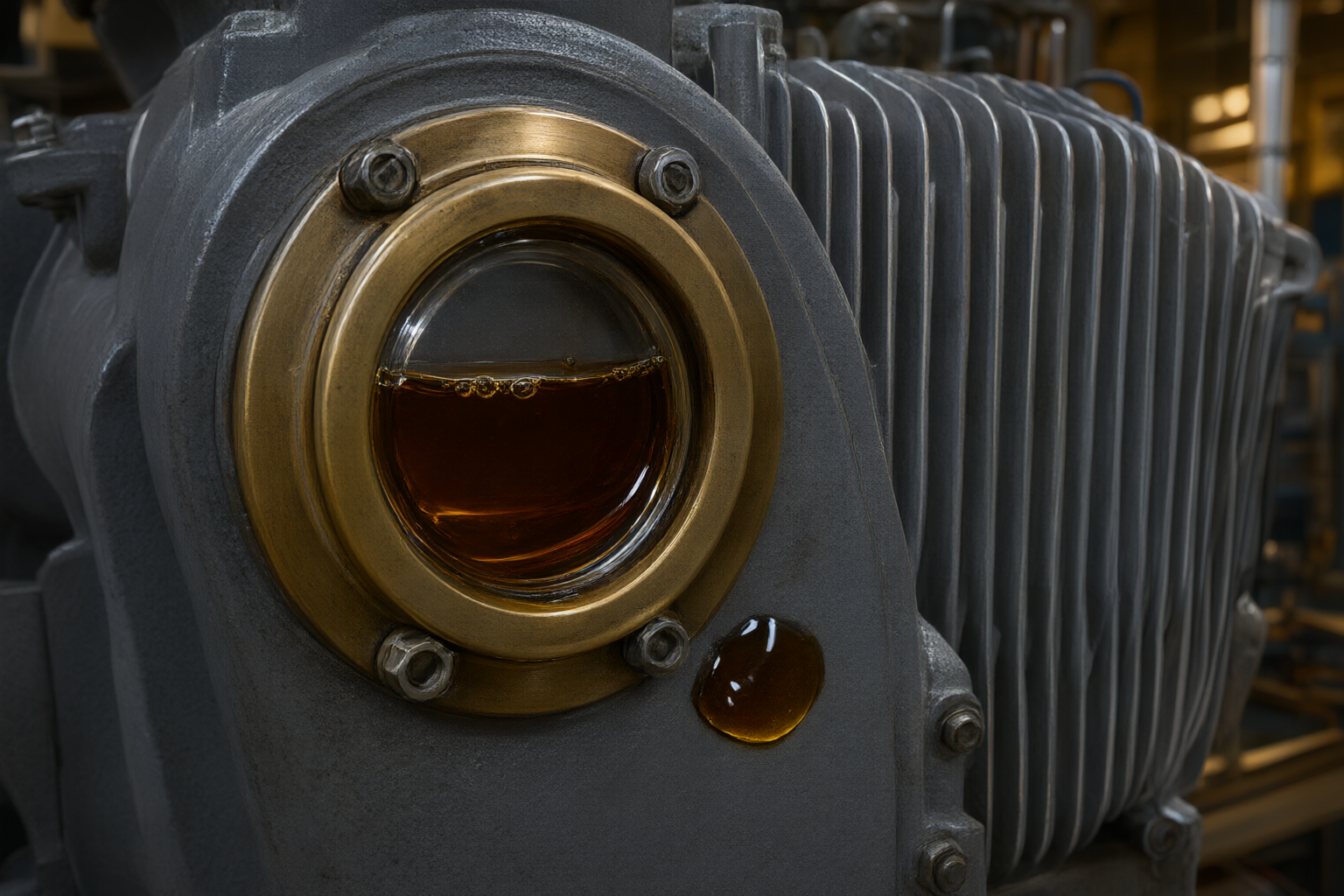
- Refuel to the specified range indicated by the oil level sight glass or dipstick, then run the equipment for a short period before rechecking the oil level and topping up as needed.
- Record the oil change date, operating hours, and oil type as a reference for the next maintenance.
Common misconceptions
- Only topping up the oil without changing it: When the oil level is low, you simply add more oil, but if the existing oil has already degraded, adding fresh oil cannot restore its performance.
- Arbitrarily extending the maintenance interval: The cost savings from delaying an oil change may be offset by the repair expenses resulting from accelerated wear.
- Blending of lubricants: Different base oils and additive packages may be incompatible, leading to performance degradation or even deposit formation.
- Simply copying others’ maintenance cycles: Since site conditions, loads, and lubricants vary significantly, someone else’s cycle may not be suitable for your equipment.
Recommended actual implementation
If you’re unsure how often to change the oil in your equipment, follow this procedure: First, consult the equipment’s instruction manual or maintenance guide; if you can’t find it, contact the equipment supplier for confirmation; then, based on site conditions such as dust levels, temperature, and humidity, determine whether the interval needs to be shortened. At the same time, maintain a maintenance log to record each oil change date and operating hours. After accumulating several cycles of data, you can determine an oil-change interval that best suits your specific operating environment by assessing the actual condition of the lubricant.
There are no comments yet. Be the first to comment!