
30 m³/min This refers to the air compressor’s displacement (volumetric flow rate), which by itself cannot be directly converted into a specific power rating. For compressors with the same displacement, the motor power required can vary significantly depending on the discharge pressure, the machine’s design, and its energy efficiency class. In industrial applications, where compressed air is most commonly used, 0.7~0.8 MPa Under the configuration of a screw compressor with oil injection (gauge pressure), 30 m³/min The motor power of the model typically ranges around 160~200 kW Range, common settings are 160, 185, 200 kW The specific values shall be subject to the manufacturer’s data sheet and nameplate.
Why can’t displacement directly determine power?
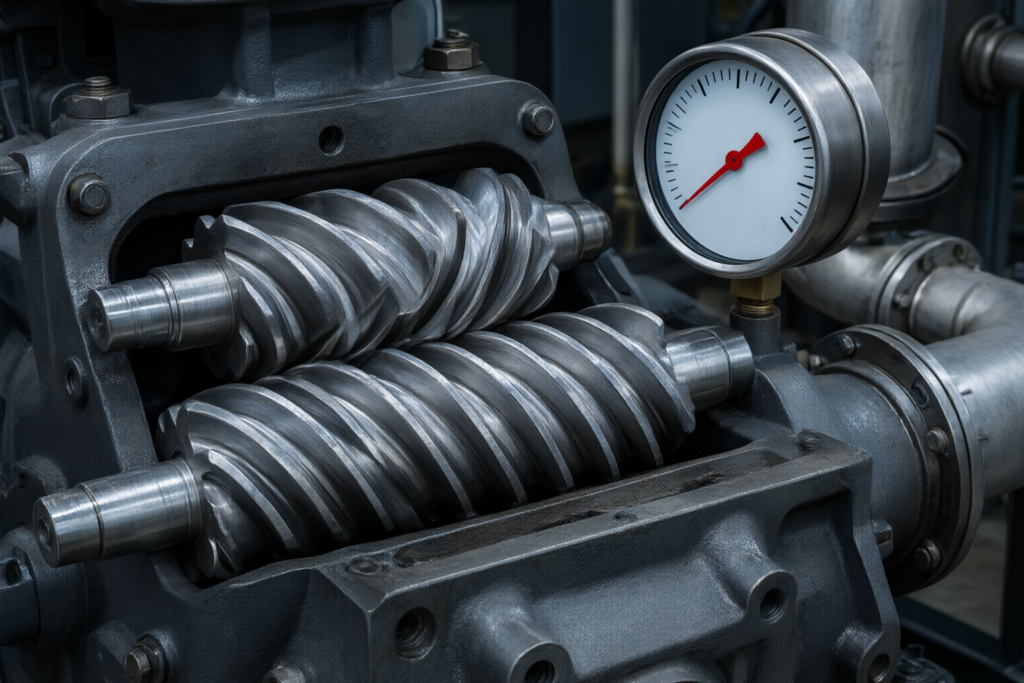
The power of an air compressor is related to its air displacement through the “specific power,” which refers to the power required per unit of air output. 1 m³/min The power consumed by compressed air is commonly expressed in the unit of kW /(m³/min). The estimated relationship is:
Engine power ≈ Specific power × Displacement
The main variables affecting specific power include:
- Discharge pressure: The higher the pressure, the greater the compression work required, and the higher the specific power.
- Model types: The specific power requirements differ significantly among oil-injected screw, oil-free screw, reciprocating piston, and centrifugal compressors.
- Compression stages: Two-stage compression typically consumes less power than single-stage compression at common pressures.
- Energy efficiency rating: For models of the same specifications but with different energy efficiency ratings, the difference in specific power can be quite significant.
- Test conditions: The specific power is typically measured under the specified intake temperature and pressure conditions; deviations from these conditions require correction.
30 m³/min Method for estimating the power of a model
Taking the most common oil-injected screw compressor as an example, in 0.7~0.8 MPa At the discharge pressure, the specific power of commonly used models in the industry is generally around approximately 5.5~7.5 kW /(m³/min) the range (there are significant differences among different energy efficiency ratings). According to 30 m³/min Calculate:
- Lower limit: 30 × 5.5 ≈ 165 kW, corresponding to models with better energy efficiency levels;
- Maximum: 30 × 7.5 ≈ 225 kW, corresponding to models with generally average energy efficiency or higher-than-normal pressure.
Therefore, the motor gear settings are mostly concentrated in 160~200 kW, a small number of configurations will arrive. 220 kW Left and right. If the actual exhaust pressure is not… 0.7~0.8 MPa It should be recalculated based on the actual pressure. The following table is for preliminary estimation purposes only and does not constitute specific product parameters.
| Configuration conditions | 30 m³/min Common power levels (for reference) |
|---|---|
| Oil-injected screw compressor, approximately 0.7 MPa | About 160~185 kW |
| Oil-injected screw compressor, approximately 0.8 MPa | About 185~200 kW |
| Oil-free model (same pressure) | Usually higher than fuel-injected models. |
| Higher pressure (approximately 1.0 MPa and above) | Needs to be calculated separately for each specific model. |
The impact of model differences on power output
- Oil-free screw compressors: The efficiency loss resulting from their oil-free lubrication design typically results in higher power ratings for the same specifications compared to oil-injected models.
- Reciprocating compressors: They are commonly used in high-pressure applications, where power is closely related to the number of stages and must be calculated based on the specific design.
- Centrifugal machines: more commonly used in applications with larger displacements, 30 m³/min It falls into the lower displacement category; whether it is applicable depends on the manufacturer’s model range.
- Two-stage oil-injection screw compressor: Offers good energy efficiency at typical operating pressures and may have a lower power rating for the same displacement.
In addition to power, the following items should also be verified during equipment selection.
- Actual operating gas pressure: Determine it based on the highest required pressure at the terminal plus pipeline pressure losses; do not arbitrarily select a higher pressure setting, as each increase in pressure level results in a corresponding rise in power consumption.
- Gas consumption fluctuations and capacity margin: When gas consumption fluctuates significantly, consider using a variable-frequency model. The installed capacity margin should be set appropriately; an excessively large margin will result in prolonged no-load operation and energy waste.
- Environmental conditions: High temperatures or high altitudes will reduce the actual displacement; please confirm the correction factor with the manufacturer.
- Motor starting method: For high-power motors, it is necessary to verify that the star-delta, soft-start, or variable-frequency drive (VFD) starting method is compatible with the grid capacity.
- Energy efficiency rating: For engines with the same displacement, the lower the specific power, the more energy-efficient it is; over the long term, electricity costs typically far outweigh the initial purchase price difference.
- Post-processing equipment, such as dryers and filters, has its own power consumption and is not included in the main unit’s power rating; however, it does affect the overall electrical distribution design.
How to obtain accurate power values
- Consult the manufacturer’s data sheet: the data sheet will provide the discharge volume, motor power, and specific power corresponding to each specified pressure.
- Refer to the equipment nameplate: motor power, rated pressure, and air displacement are the most direct indicators.
- When requesting a quote, clearly specify the operating conditions: provide the manufacturer with the air displacement, pressure, and ambient conditions, and request the power and energy efficiency data for the corresponding model.
- Verify test conditions: Confirm the operating conditions corresponding to the sample data to avoid directly comparing data from different conditions.
30 m³/min There is no single answer to the power of an air compressor: 0.7~0.8 MPa Oil-injection screw compressors typically correspond to 160~200 kW For a given model, configurations with higher pressure, oil-free design, or lower energy efficiency will typically require greater power. When selecting equipment, first determine the actual operating pressure and model type, then use the manufacturer’s specific power data from their catalog for calculation. At the same time, verify the electrical supply capacity, starting method, and energy efficiency rating to avoid underestimating power requirements based solely on air displacement, which could result in insufficient power supply or excessively high long-term energy consumption.
There are no comments yet. Be the first to comment!